IT Staff Augmentation in 2026: The Market Has Spoken — Are You Listening?
Category: Staff Augmentation | IT Consulting | Tech Talent Read Time: 12 Minutes
Introduction: The Talent Economy Has Permanently Shifted
Imagine this. Your product roadmap is locked. Your investors are watching. Your competitor just shipped a major feature update — built by an augmented team they spun up in under a week. Meanwhile, your HR team is still scheduling third-round interviews for a cloud architect who may or may not accept your offer.
This is the reality for hundreds of enterprises in 2026. And it is not a temporary problem. It is structural.
The way businesses build technology teams has fundamentally changed. Permanent hiring — once the gold standard of enterprise talent strategy — is now too slow, too expensive, and too rigid for the pace at which modern digital products need to move. The companies winning in 2026 are not necessarily the ones with the biggest budgets. They are the ones who figured out how to access the right talent, at the right time, without the overhead of traditional recruitment.
That model has a name: IT Staff Augmentation.
And right now, it is not just growing. It is exploding.
The Market Is Sending a Clear Signal — Are You Listening?
Before diving into trends, let’s anchor this conversation in data. Because this is not hype. The numbers behind IT staff augmentation in 2026 tell a story of a market undergoing a generational shift.
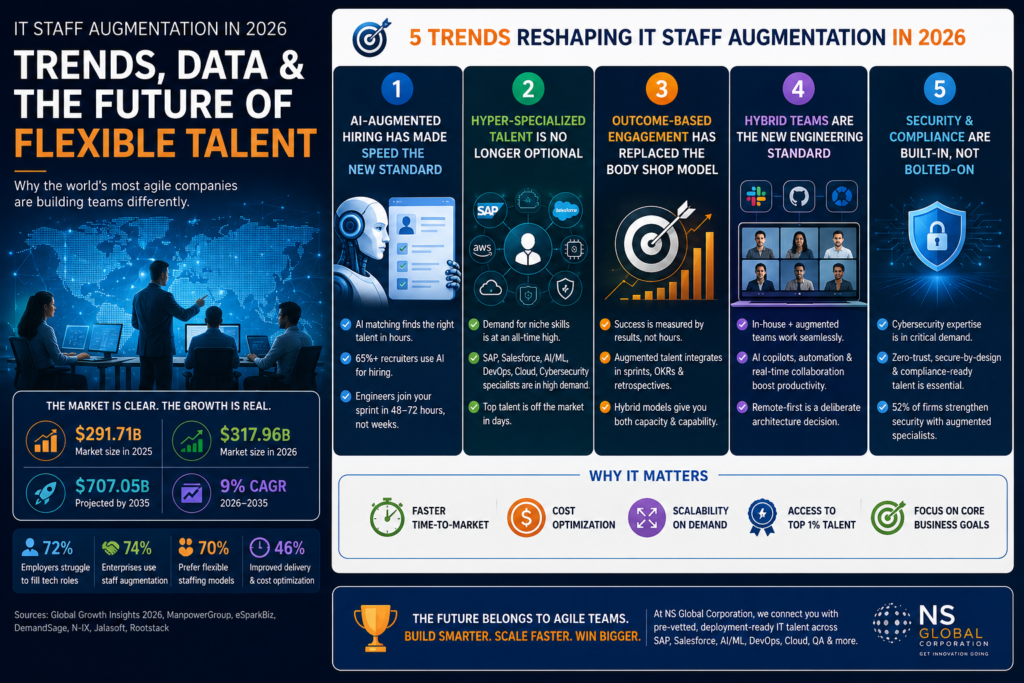
The global IT Staff Augmentation and Managed Services market was valued at $291.71 billion in 2025. It is projected to reach $317.96 billion in 2026 — and expand all the way to $707.05 billion by 2035, growing at a compound annual growth rate of 9%. (Source: Global Growth Insights, 2026)
Let that sink in. A near-trillion-dollar market is being built on one core insight: enterprises cannot hire fast enough through traditional channels to keep up with the speed of digital transformation.
And the talent shortage is making this worse, not better.
72% of employers globally report serious difficulty filling tech roles. The demand for AI capabilities, cloud engineering, SAP consulting, and DevOps expertise is massively outpacing the supply of qualified professionals in any single hiring market. (Source: ManpowerGroup Talent Shortage Survey, cited by eSparkBiz 2026)
74% of enterprises are already using staff augmentation services to overcome these shortages. This is no longer an alternative strategy. It is the mainstream approach for companies that want to compete. (Source: Global Growth Insights, 2026)
70% of firms now prefer flexible staffing models over expanding permanent headcount — because flexibility is not just a cost strategy anymore. It is a competitive advantage. (Source: Global Growth Insights, 2026)
The market has spoken. The question now is not whether to augment your team. It is how well you execute it, and whether you are choosing the right partner.
5 Trends Reshaping IT Staff Augmentation in 2026
Trend 1: AI-Augmented Hiring Has Made Speed the New Standard
The old way: Post a job. Collect 200 resumes. Screen manually. Interview four rounds. Extend an offer. Wait two weeks for a decision. Onboard for six weeks. Hope it works.
The 2026 way: AI-driven matching identifies the right candidate from a pre-vetted pool in hours. Skills assessments are automated. Background verification is instant. The engineer joins your sprint by Monday.
Over 65% of recruiters now use AI tools to support talent acquisition — from resume screening and skills matching to interview scheduling and predictive performance scoring. The result? Time-to-fill for even the most niche technical roles has compressed from weeks to days. (Source: DemandSage, cited by N-IX 2026)
And 67% of hiring professionals report that AI tools save them significant time — time that translates directly into faster team assembly and faster product delivery.
For companies using IT staff augmentation in 2026, this means that when you reach out to a quality provider, you should expect talent on your team within 48 to 72 hours. Not 48 to 72 days.
At NS Global Corporation, this is exactly how we operate. Our pre-vetted talent pool of SAP, Salesforce, AI/ML, DevOps, Full-Stack, and QA engineers is always live, always assessed, and always deployment-ready. When you identify a gap, we close it — fast.
Trend 2: Hyper-Specialized Talent Is No Longer Optional
For years, staff augmentation was associated with generalist developers — competent engineers who could handle a range of tasks but rarely brought deep domain expertise. That era is over.
In 2026, the complexity of enterprise technology stacks has increased dramatically. SAP S/4HANA migrations require specialized consultants who understand both legacy ABAP and modern cloud integration. Salesforce implementations demand architects who know not just the platform, but the industry workflows it needs to serve. AI and machine learning projects need engineers who can not only write Python but understand model training pipelines, data engineering, and deployment at scale.
Tighter budgets and longer project timelines are forcing enterprises to be extremely precise about where they allocate talent. Hiring a generalist to do a specialist’s job does not just slow you down — it creates technical debt that haunts you for years.
The demand for hyper-specialized expertise has become unmistakable across every category:
- SAP ABAP, S/4HANA, SAP Techno-Functional, SAP MDG, SAP WM consultants who understand both the technical and business layers
- Salesforce CRM architects who can design, implement, and optimize complex enterprise deployments
- Multi-cloud DevOps engineers who work across AWS, Azure, and GCP simultaneously
- AI/ML and Data Science specialists who can take a business problem from raw data to production model
- QA Automation engineers skilled in Selenium, Appium, Tricentis Tosca, and modern CI/CD testing pipelines
- Cybersecurity specialists who understand zero-trust architecture and secure-by-design development
These professionals do not stay on the market for long. Cybersecurity professionals, AI architects, and multi-cloud engineers receive multiple competing offers within days of becoming available. The only way to access them consistently is through a partner who has already built and maintained relationships with these specialists over years.
That is the NS Global Corporation advantage. Our talent network spans 15+ countries and includes deep benches of specialists across every major enterprise technology domain — ready to deploy when your project demands it.
Trend 3: Outcome-Based Engagement Has Replaced the Body Shop Model
There was a time when staff augmentation meant buying hours. A vendor would supply a developer, bill you by the hour, and leave project outcomes largely to you. Success was loosely defined and even more loosely tracked.
That model is dying — and rightly so.
In 2026, leading staff augmentation services increasingly incorporate outcome-based engagement models tied to business results rather than hours logged. Clients expect their augmented engineers to operate inside sprint cycles, contribute to OKRs, participate in retrospectives, and be accountable for the features they ship — not just the hours they clock. (Source: Jalasoft, 2026)
This shift reflects a deeper change in how enterprises think about external talent. Augmented staff are no longer hired hands. They are integrated contributors. They use your tools, align with your processes, attend your standups, and care about your roadmap.
The practical impact of this shift is significant:
Providers now offer hybrid structures combining dedicated teams with specialized skill augmentation — giving clients the flexibility to scale both capacity and capability simultaneously. You can have a core dedicated team for long-term product development and pull in sprint-based specialists for specific technical challenges, all from a single augmentation partner.
This is the model NS Global Corporation has built. Whether you need a long-term dedicated development team or a rapid specialist injection for a specific project phase, our engagement structures are designed around your outcomes — not our billing hours.
Trend 4: Hybrid Teams Are the New Engineering Standard
The idea that a great engineering team must sit in the same office died somewhere around 2020. By 2026, that idea has been replaced by something more sophisticated: the hybrid team model, where in-house talent and augmented specialists work together so seamlessly that the seams are invisible.
By 2026, it has become standard to work with mixed teams: engineers supported by AI code copilots like GitHub Copilot and Amazon CodeWhisperer, automated testing frameworks, intelligent DevOps pipelines, and real-time collaboration tools that eliminate the friction of distributed work. (Source: Rootstack, 2026)
46% of US businesses already report improved cost optimization and faster project delivery through staff augmentation and managed service integrations. (Source: Global Growth Insights, 2026)
Remote-first is no longer a compromise — it is a deliberate architecture decision for high-performing teams. And the data supports it:
- Cloud migration projects have risen by 41%, with most being executed by hybrid in-house and augmented teams
- Cybersecurity management solutions have seen a 35% increase in adoption, primarily driven by the need for specialized remote expertise
- 52% of firms are enhancing their cybersecurity focus through augmented specialist teams who bring focused expertise that generalist in-house teams simply cannot replicate
The key to making hybrid teams work is not just finding technically strong engineers. It is finding engineers who communicate proactively, integrate culturally, and operate with the same accountability standards as your permanent staff. At NS Global Corporation, every augmented professional we place goes through not just technical assessment but communication and collaboration evaluation — because a great engineer who cannot operate in a distributed team is not a great fit.
NS Global Corporation has spent over 15 years helping global enterprises close talent gaps, build dedicated engineering teams, and deliver technology projects faster than they ever thought possible through IT staff augmentation.
Whether you need a single SAP consultant by next week, a full dedicated development team for a 12-month product build, or a rapid AI/ML specialist to accelerate your digital transformation — we have the talent, the process, and the track record to make it happen.